
Floor Bounce and Sagging Supports in a Ladson Crawlspace — A Foundation Settlement Case
A Ladson homeowner had visible floor bounce and a 1.4-inch beam deflection caused by four failed wood support posts rotted at the soil contact point. Crawlspace Correct replaced all six posts with adjustable steel foundation jacks on engineered concrete pads and installed a 16-mil vapor barrier.
The Problem
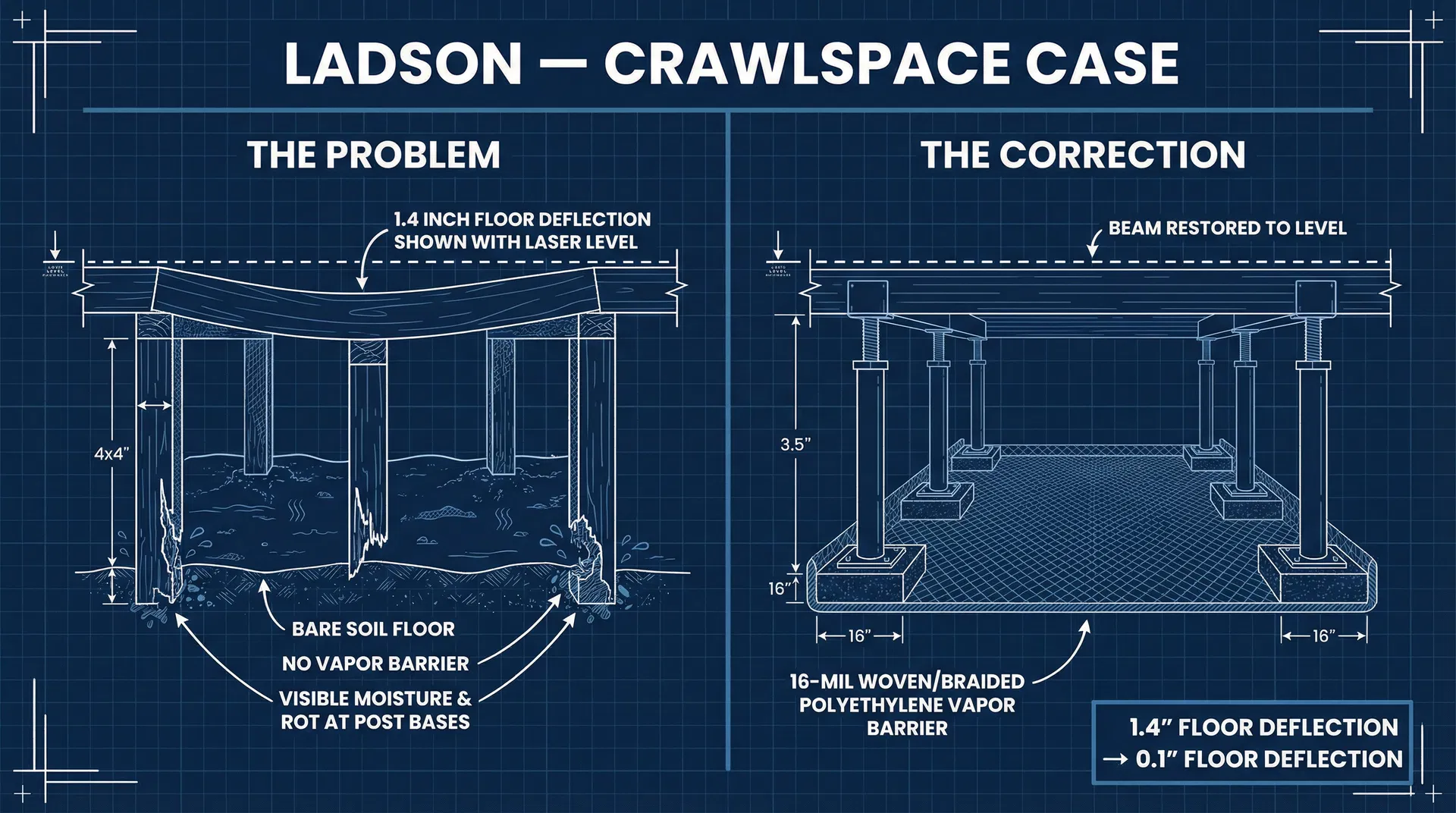
The homeowner contacted Crawlspace Correct after noticing a noticeable bounce in the kitchen floor and a visible dip near the center of the living room — a low point that had developed gradually over roughly three years. During the Crawlspace Blueprints™ inspection, we found a 1,340-square-foot crawlspace with six interior wood support posts, four of which had failed at the base. The posts were original construction — 4x4 pressure-treated pine set directly into the soil on small concrete pads, typical of residential construction in this area from the late 1980s. Three of the four failed posts had rotted through at the soil contact point, and one had shifted laterally off its pad entirely. A laser level measurement from the main beam to the subfloor showed 1.4 inches of deflection at the center span — enough to be felt underfoot and enough to stress the subfloor sheathing. Relative humidity in the space read 78%, and the soil directly beneath the failed posts was visibly damp.
Root Cause Analysis
- The original 4x4 support posts were set directly into the soil on undersized concrete pads — a construction method that concentrates point loads on a small bearing area. In Ladson's expansive clay soil, seasonal moisture cycling causes the clay to swell and contract, which gradually rocks and tilts small-footprint pads over years of wet and dry cycles.
- The crawlspace had no vapor barrier. Bare soil was in direct contact with the base of every support post. Persistent ground moisture wicked up into the wood, accelerating rot at the soil contact point — the most vulnerable location on any wood post installation.
- The center span between the perimeter foundation wall and the main beam was 11 feet — at the upper limit of what the original framing was designed to carry without intermediate support. Once two of the six posts failed, the remaining four were carrying load they were not sized for, accelerating the deflection rate.
Ladson's soil profile is predominantly Coxville and Goldsboro series — fine sandy loam over clay, with a seasonal high water table that can reach within 12 inches of grade during wet winters. This soil type has low bearing capacity when saturated, which is why undersized post footings in this area tend to migrate over time rather than hold position. It is a geography that requires engineered bearing surfaces, not builder-grade pads.
The Correction
The Crawlspace Blueprints™ diagnostic report called for full removal of all six original wood posts and replacement with adjustable steel foundation jacks on poured concrete bearing pads. The four failed posts were removed first. The soil beneath each post location was excavated to a depth of 4 inches and compacted. New concrete bearing pads — 16 inches square by 4 inches thick — were poured at each of the six support locations and allowed to cure for 48 hours before jack installation. Six adjustable steel foundation jacks with 3.5-inch diameter steel columns and 7-inch square base plates were installed, each set to the correct height using a laser level to bring the main beam back to within 0.1 inches of level across the full span. The adjustment collars were torqued and locked. A 16-mil Woven/Braided Polyethylene Vapor Barrier was installed across the full 1,340-square-foot floor as part of the same scope — addressing the moisture condition that had caused the original post rot and preventing recurrence on the new steel hardware.
Results
Post-installation laser level measurement confirmed the main beam was restored to within 0.1 inches of level across the full span — down from the pre-installation deflection of 1.4 inches. The homeowner confirmed the floor bounce was eliminated at the final walkthrough. At the 30-day follow-up, the crawlspace humidity had dropped from 78% to 54% with the vapor barrier in place and no dehumidifier — the barrier alone was sufficient to bring the space into an acceptable range given the absence of active water intrusion. The subfloor sheathing, which had shown early signs of delamination at the low point, was dry and stable at re-inspection.
Foundation settlement in Ladson and the surrounding Dorchester County corridor is frequently a compounding problem — the same moisture conditions that rot wood posts also compromise the soil bearing capacity beneath the footings. The two issues are connected, and addressing only one without the other leaves the correction incomplete. If you are noticing floor movement, squeaking at specific points, or doors that have started sticking in frames that used to close cleanly, those are early indicators worth investigating before the deflection progresses further. A free Crawlspace Blueprints™ inspection will document the current condition of your support system and give you a clear picture of what, if anything, needs to be addressed.
Is your crawlspace showing similar signs?
Get a free Crawlspace Blueprints™ inspection — same-day diagnostic report.