
Torn Vapor Barrier and 87% Humidity in a Hanahan Crawlspace — What We Found
A Hanahan homeowner noticed musty odors and soft flooring. The Crawlspace Blueprints™ inspection revealed a failed 6-mil vapor barrier, 87% relative humidity, and early joist mold — corrected with full 16-mil encapsulation and an AprilAire 70-pint dehumidifier.
The Problem
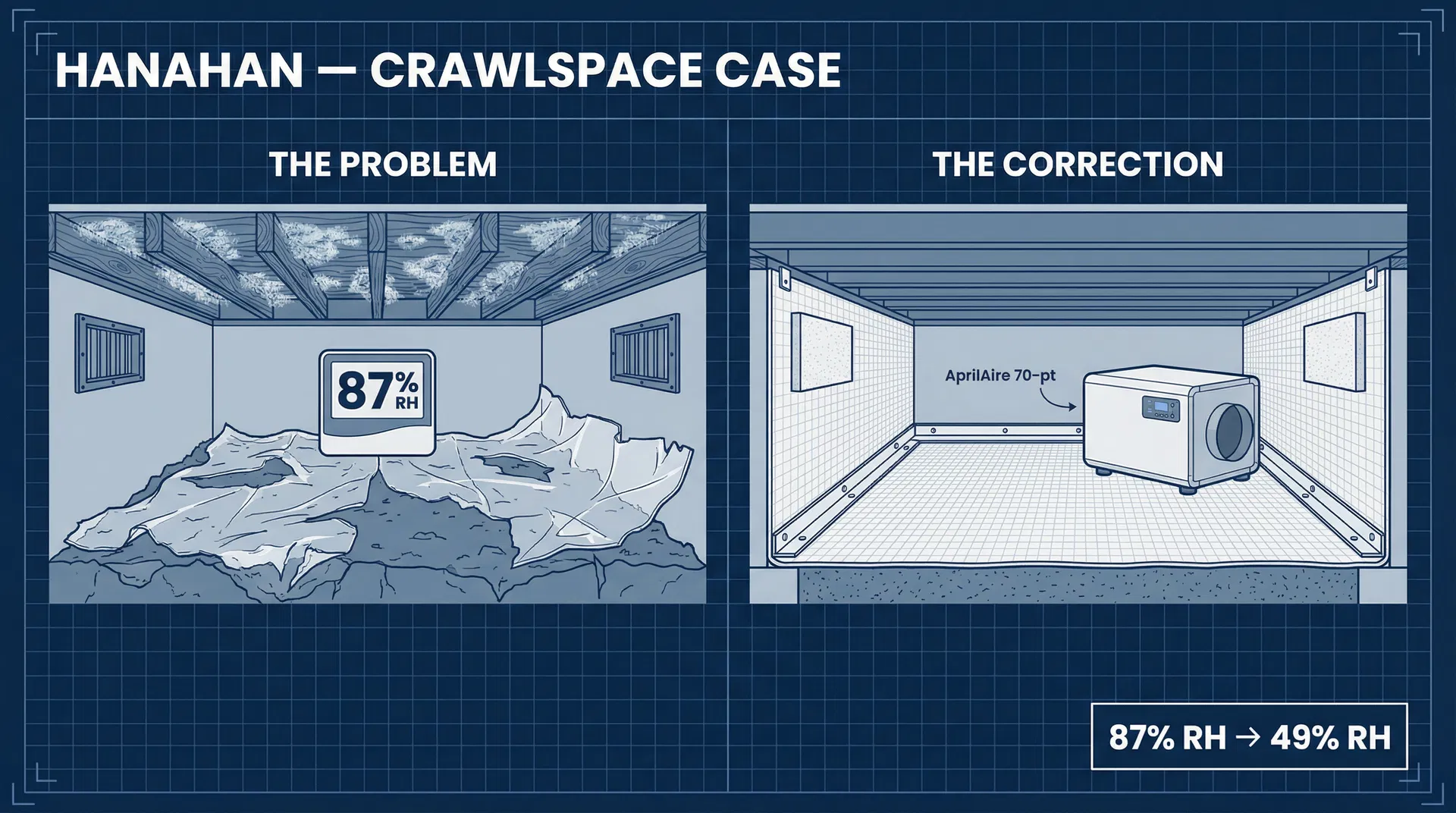
The homeowner called after noticing a persistent musty odor on the first floor and a soft, spongy feel in the hallway floor near the center of the house. During the Crawlspace Blueprints™ inspection, we found a 1,100-square-foot crawlspace with a deteriorated 6-mil polyethylene vapor barrier — the original builder-grade sheet installed when the home was constructed in 1997. Roughly 40% of the barrier had torn away from the perimeter walls and was lying in overlapping folds across the soil floor, leaving large sections of bare earth fully exposed. A digital hygrometer placed at the center of the space read 87% relative humidity. Soil moisture at three test points ranged from 28% to 34% volumetric water content. Two floor joists directly above the exposed soil showed visible surface mold growth and early-stage wood softening — not structural failure yet, but within 12 to 18 months of becoming a repair problem.
Root Cause Analysis
- The original 6-mil poly barrier had no mechanical fastening to the foundation walls — it was laid flat on the soil and held in place only by its own weight. Over 28 years, HVAC vibration, minor settling, and foot traffic during prior HVAC service calls caused progressive tearing and displacement.
- The crawlspace had four passive foundation vents, two of which were stuck open year-round. In Hanahan's summer months, outdoor air at 90°F and 75% relative humidity enters the cooler crawlspace, drops in temperature, and the relative humidity spikes — a textbook stack effect cycle that a passive vent system cannot interrupt.
- No dehumidification equipment was present. The space was relying entirely on passive ventilation to manage moisture, which is inadequate for a sealed slab-on-grade neighborhood with Hanahan's tidal proximity and clay-heavy subsoil.
Hanahan sits at the confluence of Goose Creek and the Back River tidal system. The water table in this zone is typically 18 to 36 inches below grade, and the soil profile is predominantly expansive clay with organic fill layers in lower-lying lots. That combination means ground moisture is a constant upward pressure, not a seasonal event — and a compromised vapor barrier in this geography is not a cosmetic issue.
The Correction
The Crawlspace Blueprints™ diagnostic report identified three required scopes: full barrier removal and replacement, vent sealing, and active dehumidification. The existing 6-mil poly was removed in full — no patching over a failed barrier. The soil floor and perimeter footings were swept and inspected for standing moisture before installation began. A 16-mil Woven/Braided Polyethylene Vapor Barrier was installed across the full 1,100 square feet of floor, lapped 12 inches at all seams and sealed with butyl tape, and mechanically fastened to the foundation walls with termination bar at 16-inch intervals to a height of 6 inches above grade. All four passive foundation vents were sealed with rigid foam inserts and spray foam perimeter seals. An AprilAire 70-pint commercial crawlspace dehumidifier was installed on a dedicated 15-amp circuit, positioned at the geometric center of the space for maximum air circulation coverage, with the condensate line gravity-draining to the exterior. The two floor joists showing surface mold were treated with a borate-based wood preservative and re-inspected before the barrier was laid.
Results
At the 30-day follow-up reading, the crawlspace registered 49% relative humidity — a 38-point reduction from the pre-installation baseline of 87%. The musty odor on the first floor was no longer detectable at the 2-week mark. The homeowner reported that the spongy floor feel had firmed up, consistent with the floor joists drying out and regaining dimensional stability. The AprilAire unit was cycling approximately 11 hours per day during the first two weeks of operation, dropping to 6 to 7 hours per day once the space reached equilibrium — a normal pattern as the soil and framing release stored moisture.
"The smell was the thing that finally got me to call. I had been ignoring it for two years thinking it was just an old house. Turns out the whole floor under there was basically sitting on wet dirt." — Hanahan Homeowner, 2025
Vapor barrier degradation in Hanahan and the surrounding Goose Creek corridor is one of the more common findings on Crawlspace Blueprints™ inspections in this area — particularly in homes built between 1985 and 2005 when 6-mil poly was the standard builder spec. That material has a functional lifespan of 15 to 20 years under normal conditions; in a high-humidity, high-moisture-load environment like this one, it often fails sooner. If your home is in this age range and you have not had the crawlspace inspected, a free Crawlspace Blueprints™ inspection will document exactly what is down there before it becomes a structural issue.
Is your crawlspace showing similar signs?
Get a free Crawlspace Blueprints™ inspection — same-day diagnostic report.